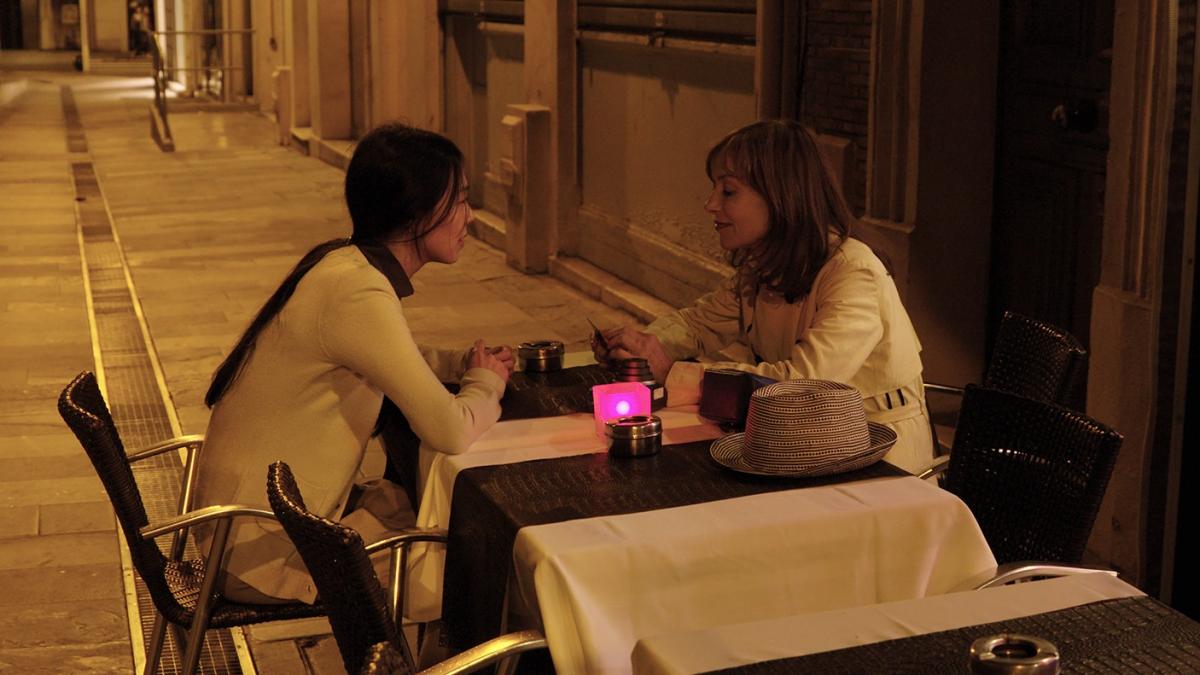
In this charming, deceptively unassuming film, young sales agent Manhee is attending the Cannes Film Festival for work when she is abruptly fired by her boss, who accuses her of being “dishonest”. Meanwhile, Claire, a Parisian schoolteacher visiting the festival for the first time, wanders the streets with her Polaroid camera, convinced that photographs have a transformative power and allow us to see things differently. When Claire bumps into Manhee and befriends her, this unlikely pair become detectives of sorts. Moving through the side streets and cafés of Cannes, far from the festival’s glare, they piece together the circumstances surrounding Manhee’s firing, developing new outlooks on life in the process.

“The film captures the uncanniness of returning to certain spaces and places you’ve been to before, in which everything seems to be as it was, except that time has passed and things aren’t quite the same.”
Peter Kim / The Brooklyn Rail
“Claire’s Camera reveals its details slowly, as Claire’s photos become a magic mirror that allows Mahnee, her boss, and the director to see each other anew. Claire’s Camera sees the truth in Susan Sontag’s idea that when we photograph other people we see them as they never see themselves. Through the process of being looked at they are transformed. As Claire says, “The only way to change things is to look at everything again very slowly.” It is what Hong asks of his audience too. Just when you think you’ve understood, he asks you to look again.”
Joanna Di Mattia / Senses of Cinema